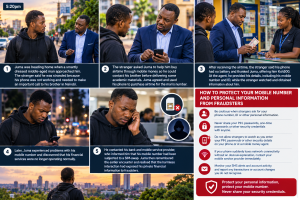
It was around 5:20pm when Juma was heading home when he was approached by a smartly dressed middle-aged man.
The stranger said he was stranded because his phone was not working and needed to make an important call to his brother, a college student in Nairobi. He asked Juma to help him buy airtime through mobile money so he could contact him before delivering some academic materials.
Juma agreed and used his phone to purchase airtime for the man’s number.
After receiving the airtime, the stranger said his phone had no battery and thanked Juma for helping. He offered him Ksh500 as a reward.
Juma initially declined, but the man insisted. He said he had cash in Ksh 1,000 denominations and suggested they visit a mobile money agent, where he would deposit the money into Juma’s mobile wallet.
What appeared to be another simple transaction would later leave Juma questioning how much personal information he had exposed during the encounter.
At the agent, Juma provided the details required to complete the transaction, including his mobile phone number and identification details. The stranger was able to observe the process and obtain information about Juma.
Later, Juma experienced problems with his mobile number and discovered that his financial services were no longer operating normally.
He contacted his bank and mobile service provider to establish what had happened. He was informed that his mobile number had been subjected to a SIM-swap, a process in which a fraudster obtains a replacement SIM card linked to a victim’s phone number.
Juma then remembered the earlier encounter and the stranger who had asked him to help with airtime before accompanying him to a mobile money agent.
It is then that he realized that the harmless interaction had exposed his private financial information to fraudsters.
How to protect your mobile number and personal information from fraudsters
As an Equity customer, remember that your mobile number can be linked to your bank account and other financial services, making it important to protect it from misuse.
Be cautious when strangers approach you with requests that require you to provide your phone number, identification details or other personal information.
Do not allow strangers to watch as you enter your PIN, passwords or other security credentials on your phone or at a mobile money agent.
Never disclose your PIN, passwords, one-time passwords or other security credentials to another person, even if they claim to be helping you with a transaction.
Be particularly cautious if your phone suddenly loses network connectivity without an obvious explanation. An unexpected loss of mobile service can have many causes, but if it happens alongside unusual activity on your financial accounts, contact your mobile service provider and Equity immediately through official channels.
You should also monitor your SMS alerts and account activity and report transactions or account changes that you do not recognize.
A simple request for assistance may appear harmless, but sharing personal or security information can give fraudsters an opportunity to target your accounts.
Protect your personal information, protect your mobile number and never share your security credentials.
For tips on secure banking, visit: https://equitygroupholdings.com/ke/secure-banking-tips/
#KaaChonjo