The African Society for Laboratory Medicine (ASLM) Special Convention on Diagnostics has concluded in Nairobi with a unified call to action, as delegates endorsed five priorities designed to strengthen diagnostic systems and accelerate Africa’s response to antimicrobial resistance (AMR).
ASLM CEO Nqobile Ndlovu underscored the urgency of confronting AMR, warning that the crisis is “getting out of hand in Africa” and that it requires immediate, coordinated, and well-resourced action.
“Over the last three days of the convention we examined the state of diagnostics of AMR from every angle- political, technical, financial, social and even operational, and a few things stood out clearly,” said Ndlovuduring the closing ceremony of the three-day forum that culminated in the Nairobi Declaration.
The five priority areas are:
- Diagnostics must become the standard of care across Africa. The war on AMR will note be won presumptive treatment where only 5–10% of inpatients on antibiotics get microbiology tests.
- AMR Surveillance must shift from projects to long-term, sustainable and predictable nationally funded programmes. Reagents, consumables, EQA and workforce must be budgeted within national health security budgets
- One Health is no longer optional — it is the backbone of AMR control. Human, animal and environmental sectors must operate as one surveillance shield.
- Africa’s diagnostic future will be digital, data-driven and decentralized. AI-enabled analytics and interoperable, multiplex-testing and AMR surveillance platforms will define the next era of health security.
- Local manufacturing is a strategic health security priority. We must accelerate local production, regulatory harmonization and demand aggregation to reduce dependence on imports.
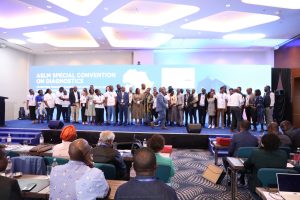
Action Plan
After adopting the high-level takeaways, the Convention outlined five action points for governments, regional bodies, development partners, civil society, and industry;
- To African Governments: We call upon all governments to establish dedicated national budget lines that integrate AMR diagnostics and surveillance into UHC benefits.
- To Africa CDC and Regional Bodies. Support Member States with advocacy and elevation of AMR to AU Heads of State agendas
- To Donors and Global Partners. Align behind Africa’s investment case and shift from isolated projects to flexible, multi-year catalytic funding.
- To Civil Society and Communities. Develop AMR accountability scorecards, advocate for diagnostic access, and educate communities on responsible antibiotic use and stewardship.
- To Industry and the Private Sector. Engage fully in the ASLM Industry Forum to co-create end-to-end, Africa-appropriate diagnostic solutions, including local manufacturing and service ecosystems.
“The convention has made one thing unmistakably clear: Africa is no longer responding to AMR through fragmented or isolated efforts. We are responding with evidence, with coordination, with innovation and increasingly with our own domestic investment,” said the ASLM CEO.
Ndlovu exuded confidence that once political will is translated into concrete action, there is window to contain AMR.